
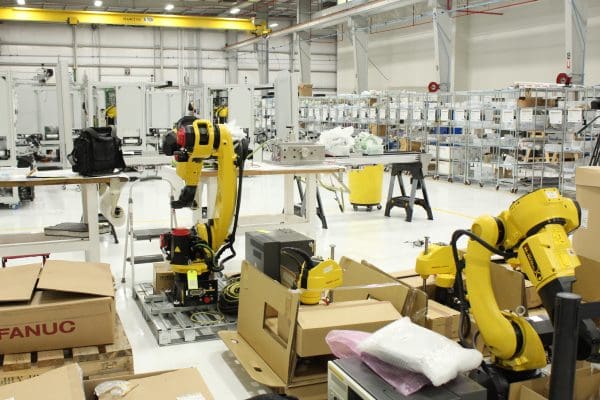
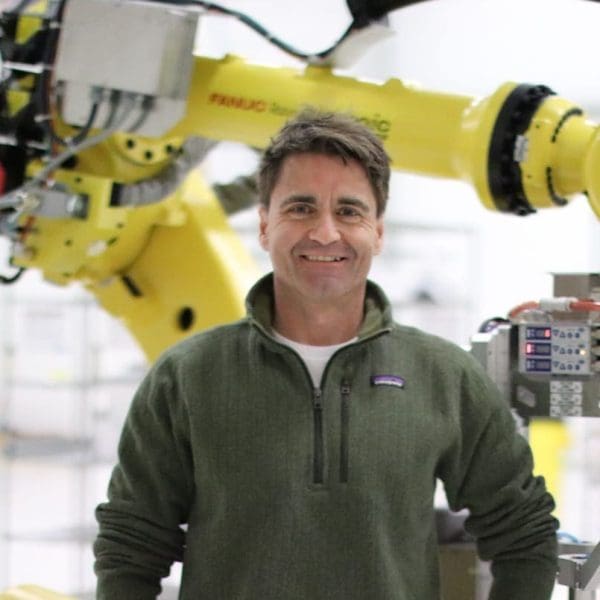
Founded in 1995 by Jim Peyton, Kinemetrix designs and builds the machines that manufacturers use to make their products. It specializes in custom robotic assembly and test systems, bringing together mechanical design, robotics, machine vision, and software to create a complete production system. Its customers are market leaders who manufacture high-value, often safety-critical assemblies. They need equipment that meets demanding production and quality requirements, day after day. Kinemetrix builds systems that are safe, productive, and adaptable to changes in product designs, production volumes, and operating conditions.
When asked if he envisioned the kind of growth Kinemetrix has seen in 30-plus years, Jim Peyton said, “Yes. Envisioning the company we wanted to build was the starting point. The company was founded on a handful of guiding principles. Most of them around mutual respect for the team, and creating win-win business relationships with customers and suppliers. Fast forward 30 years, and those same principles are guiding our decisions and culture today.”
As an engineer, Peyton said he has always liked to understand how things work. “It turns out that most business problems can be framed as engineering problems,” he added. “As we develop the company’s people, processes, and capabilities, we’re building a machine to build machines.”
How would you describe your leadership/management style? Any changes over time?
“Let’s just say that micromanagement gets a bad rap. In our business, a missed detail can have serious financial or safety consequences. We expect everyone to take ownership of the details in their work. Our new engineers are told: ‘in school 99% got you an A. Here, it’s a solid F.’ To succeed, a key skill is recognizing that human error exists and creating safeguards that detect and prevent mistakes from propagating. Today, I’m still hands-on technically, but increasingly focused on developing the people and processes that allow the company to scale.”
Culture is a big thing for companies these days as they work to attract and retain employees. Peyton said, “We’re very careful about who we hire, because we rely on each other to compete. Everyone has to pull their weight. For the same reason, trust and accountability are very important. When someone makes a mistake, they own it, learn from it, we improve our processes, and move on. Our culture is a healthy mix of mutual support and friendly competition. We all enjoy learning from each other and getting better at our craft.”
Has Kinemetrix introduced A.I. into its operations and how has the company approached its use among employees?
“We’ve launched an enterprise AI pilot. We’re developing policies to protect intellectual property, promote consistent results, and keep personal and business use separate,” said Peyton. “Our initial applications support our engineers’ work rather than directly produce customer-facing material, for example, reviewing work to suggest improvements and identify possible errors. I expect AI to contribute to our productivity and growth. Our interest is in helping capable people learn faster, examine more possibilities, and spend less time on routine work. The measure is better work and better decisions, faster.”
Being located in the Greater Lexington region has provided the company with several advantages, including access to customers, technical talent, and a strong manufacturing culture. Peyton added, “Our location along the I-75/64 corridor puts us close to important manufacturing customers. Blue Grass Airport makes for convenient business travel, while the University of Kentucky and other regional institutions provide valuable sources of talent. Toyota’s influence is another advantage. The region has developed a strong appreciation for process discipline, quality, and continuous improvement. That fits the way we approach our work.”
Kinemetrix is poised for the future as it continues to grow, following the opening of its expanded facility in 2025. Peyton said, “Our $4 million Phase II expansion gives us room to build multiple large assembly systems simultaneously and expands our in-house precision manufacturing capacity. That lets us grow with our customers and broaden our geographic reach. Phase II expansion has been operating for about a year and is already at capacity. And we’re beginning discussions with customers about a Phase III expansion into nearby satellite facilities to provide separate and secure assembly spaces for our customers with sensitive intellectual property. Most of this growth is fueled by our assembly solutions in the vehicle electrification market, with additional opportunities in medical device assembly.”